The post Tripling down on Wonderful: Building the AI operating system for the enterprise appeared first on Insight Partners.
]]>Less than a year ago, Insight Partners and Wonderful came together around a shared thesis that AI would transform the enterprise. But we knew delivering that transformation inside the world’s largest, most complex organizations would require a fundamentally different approach.
In March, we doubled down on that thesis and led Wonderful’s $150 million Series B. Less than six months later, our conviction in this team and what they can accomplish has only grown – now, we’re leading their $550 million Series C.
From AI potential to AI in production
Real enterprise workflows cut across departments, legacy systems, data environments, security requirements, and organizational boundaries. Getting an agent to perform well in a demo is one thing. Getting AI to reliably execute mission-critical work inside a global bank, telecom operator, healthcare provider, or other complex enterprises is something entirely different.
Wonderful was built on that distinction.
The company is helping some of the world’s largest organizations build the muscle required to become truly AI-native. It pairs a model-agnostic AI platform with deeply embedded local teams. Forward-deployed engineers work alongside customers to integrate with existing systems and get AI into production quickly. Deployment strategists identify where AI can generate the most impact, then scale from the first successful deployment into broader transformation.
The goal is to avoid creating dependency. Wonderful co-builds with its customers, helping them develop the in-house capabilities to build, operate, and improve AI themselves.
A thesis designed to travel
When we first invested in Wonderful, one of our strongest convictions was that enterprise AI adoption would be won locally.
Wonderful built an unconventional playbook around establishing an international presence early, with market penetration across Italy, Israel, Switzerland, the Netherlands, Greece, Poland, Romania, the Baltics, the Adriatic, and the UAE, among others. The model relied on hiring exceptional leaders in each market, surrounding them with technical and deployment talent, and giving those teams the autonomy to operate with the speed and accountability of a local company. One of the biggest questions was whether that model could travel, to which the answer has been a resounding yes.
Wonderful has now expanded across more than 35 markets, building local teams throughout Europe, the Middle East, Latin America, and Asia-Pacific. What began as an ambitious geo-by-geo strategy has become a powerful global distribution engine.
From a wedge to an enterprise-wide platform
Wonderful started with customer support, and intentionally so. Voice is high-volume, measurable, and operationally complex. It forced the team to solve the hardest problems in applied AI early: deep integrations, latency, governance, reliability, and the edge cases that only emerge when AI interacts with real customers at scale.
But customer support workflows rarely stay contained. Resolving a billing issue may require finance systems. Troubleshooting a service may touch IT and operations. Once Wonderful was deeply integrated into these environments, the opportunity expanded naturally.
Customers are now using Wonderful across customer-facing, employee, and back-office workflows. Forward-deployed engineers increasingly become extensions of customers’ own teams, and across our diligence, the enthusiasm was unusual for enterprise software, driven not just by the technology but by the speed and caliber of the people behind it.
We increasingly see Wonderful as an AI operating system for the enterprise, a shared layer through which organizations can deploy, govern, and scale AI across the workflows that run their businesses. Every successful deployment makes the next one easier. Integrations are reused, enterprise context accumulates, and new models can be incorporated as the frontier advances. Rather than recreating the fragmentation of the SaaS era, Wonderful has the opportunity to provide the common foundation on which enterprises build their AI-native future.
Why we’re tripling down
We’ve had the unusual opportunity to evaluate Wonderful three times in less than a year. At each stage, we’ve asked the same question: what do we believe today that we didn’t know the last time we invested?
Each time, the answer has deepened our conviction.
We know the geographic playbook travels. We know the deployment model is a genuine differentiator. We know the customer support wedge expands into much broader enterprise workflows. And we’re beginning to see how these pieces reinforce one another as Wonderful scales.
Our conviction in Bar, Roey, and the team has grown with each investment. Building at this pace while expanding the product, entering dozens of markets, hiring hundreds of people, and serving some of the world’s most demanding enterprises requires a combination of ambition, intensity, and execution.
We believe the next chapter of enterprise AI will be defined not simply by who has access to the best models, but by who can translate rapidly improving intelligence into real, durable transformation inside the world’s largest organizations. That requires world-class technology, deployment expertise, local presence, and the ability to turn one successful workflow into many.
Wonderful is building for all of it.
Wonderful is an Insight Partners portfolio company.
The post Tripling down on Wonderful: Building the AI operating system for the enterprise appeared first on Insight Partners.
]]>The post How Insight Partners’ Government Advisory Board helps companies scale in government markets appeared first on Insight Partners.
]]>For startups, winning government business means maneuvering through a maze of security, procurement, and compliance requirements that can take years to understand. Few startups know how to navigate it, and fewer still get through the door at all.
Managing Director Nick Sinai leads Insight’s government advisory practice to help portfolio companies build a thriving public sector business—across sales, marketing, compliance, and government affairs.
With federal service that includes four years in the White House Office of Science and Technology Policy, Sinai recognized that Insight and its portfolio would benefit from the strategic counsel of people who have served at the highest levels in federal agencies and the military.
“It became clear to me that we could bring…expertise, guidance, and advisory to the broader portfolio,” Sinai says. “Great government leaders, operators, policymakers who have decades of experience.”
That group became Insight Partners’ Government Advisory Board (GAB), a group of seven advisors who advise Insight and its portfolio companies about the opportunities and challenges of serving government customers.
The GAB launched in 2022, and Sinai and fellow Managing Director Richard Wells still lead the board today. The late Secretary Ash Carter, the 25th United States Secretary of Defense and longtime Professor at Harvard University’s Kennedy School of Government, also previously served as the chair of the GAB.
Meet the board
The board was deliberately built to represent a wide range of leadership and policy-making experience across federal civilian, defense, and intelligence agencies. What unites its members, says Sinai, has less to do with their resumes than a shared instinct.
“They’re passionate, as am I, about great software and technology and AI to support the mission, and they understand how hard it is to buy and scale great technology in government.”
General (ret.) Joseph Votel spent 39 years in uniform, commanding special operations and conventional forces at every level, including as Commander of U.S. Central Command and U.S. Special Operations Command. On the GAB, that translates into direct, practical counsel. “The biggest way I’ve been able to help Insight is by advising leadership…on people and organizations that they ought to reach out to,” he says, “and demonstrating how these kinds of software-based solutions can really make a difference for our military forces.”
On the cyber and IT front, the board includes Essye Miller, former Principal Deputy and Department of Defense Chief Information Officer. “I spent 35 years with the Department of Defense with a career spanning information technology, information management, and cybersecurity,” says Miller.
General (ret.) Timothy Haugh, former Director of the NSA and Commander of U.S. Cyber Command, has deep experience in leading large technology organizations in the government. “We (the GAB) help companies put into context what the challenges the government has, and how portfolio companies can position themselves in a way to align their product and their talents with a clear national security need.” Haugh says.
Lieutenant General (ret.) Jack Shanahan brings a similar depth in defense technology, having built and led Project Maven and the Department of Defense’s first two dedicated AI programs. “My experience was really as the CEO founder,” he says, “[so I] can be very sympathetic and empathetic with all the founders who are taking these companies and trying to get business with the national security enterprise.”
On acquisition and policy is the Honorable Dr. Will Roper, who, as the Air Force and Space Force’s top acquisitions executive, controlled an annual budget of $60B — a vantage point on government spending that most founders never get close to. “I enjoy working with Insight portfolio companies because it just continues what I loved when I was in government service,” he says.
Nicole Wong has sat on both sides of the table, having served as U.S. Chief Technology Officer under President Obama, Google’s vice president and Deputy General Counsel, and Twitter’s (now X) Legal Director for Products. “I specialize in advising high-growth, high-technology companies, primarily in the area of international regulation for privacy and content, and of course, most recently, AI,” she says.
The Honorable Sue Gordon brings decades of intelligence leader to the group. A former Principal Deputy Director of National Intelligence, Deputy Director of the National Geospatial-Intelligence Agency (NGA), and senior CIA official, she is an expert on innovation, cybersecurity, and emerging technologies. Among her many accomplishments to drive partnerships and leverage innovation, Gordon led the establishment of In-Q-Tel, the CIA’s venture arm.
“Use us as a testing board of ideas”
There’s no single template for how GAB members work with portfolio companies. “My mission is to matchmake,” says Sinai. He pairs advisors and founders based on sector, agency, and stage. Some relationships become formal advisory positions; others are lighter touch, such as a check-in before a board meeting or a second opinion on a GTM plan.
Some founders benefit from personal, subject-specific sessions, says Miller. “To sit down and do a one-on-one of, ‘Here’s what the organization looks like, here’s how they operate, here’s where you need to target your conversations, and here are the rules and regulations that go along with that’ — it becomes a little less mysterious for them and helps them shape their strategy much better.”
Others work on the group level. Haugh says that one of the best ways to leverage the GAB’s joint expertise is to “use us as a testing board of ideas,” inviting members to critique approaches before taking them to a government customer.
A common thread for all the GAB members is their role as translators. “If you don’t have the language right, what might have been a great opportunity turns into a detriment,” says Roper. “I find most [founders] don’t understand the inner workings, and they shouldn’t, because they’ve not had that experience,” agrees Miller. “[Making] it a bit clearer and less of a gray space [allows founders] to take advantage of the opportunities that are available.”
Shanahan’s role is often about redirecting a product rather than rebuilding it, helping founders see a government application for a technology they hadn’t originally considered. “That’s a wonderful piece of technology,” he tells founders, “but have you thought about it in this way? Let us point you in a slightly different direction. Here’s what we think it could do.” It’s the kind of pivot, he explains, that every startup eventually has to make.
Navigating bureaucracy
One of the main challenges portfolio companies face is discerning which government opportunities are worth chasing.
Pursuing the wrong kind of funding is risky, says Roper, who spent years approving Air Force and Space Force budgets. “I have a pretty good instinct for when something’s a dead end and when it isn’t, and that’s one of the hardest things in government to know…there’s so much R&D money that is a cul-de-sac.” Spotting that difference, he says, is one of the most valuable things the board offers.
Another recurring friction point is security accreditation: getting a company’s technology certified to run on networks with specific security requirements. “It’s not written down in one place where you can just go research it,” says Roper. “This inside baseball knowledge you pick up from within government service is often what companies need.”
Shanahan sees a broader, structural challenge. Much of the work he does with founders is about helping the Pentagon complete a shift he spent his own career working towards — moving from “an industrial age hardware company” to “a digital age software-centric company.” Companies selling into government have to navigate a bureaucracy that often stifles its own ambitions.
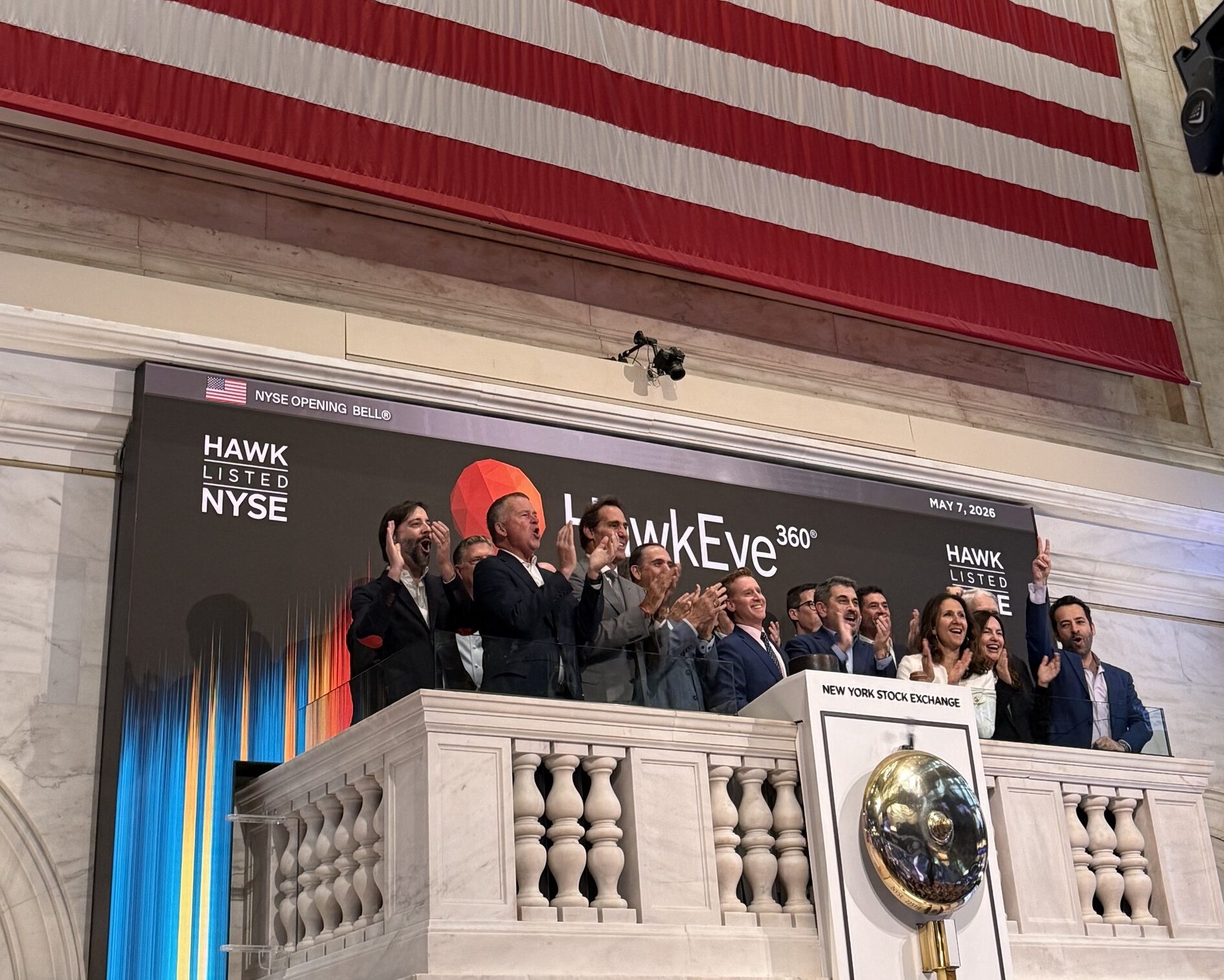
Hawkeye 360’s path to IPO
Commercial signals intelligence company HawkEye 360 has navigated those challenges with the GAB’s help. Sinai led Insight Partners’ Series D investment in the company in 2021 and served on its board for around five years, collaborating with CEO John Serafini to grow HawkEye into the leading commercial provider of space-based signals intelligence. Miller served as a formal advisor focused on IT and cybersecurity, and Gordon became a close mentor to Serafini.
The company went public in May 2026 at a $3.15B valuation, having raised $416M in its IPO. Insight retained a significant ownership post-listing, making it one of the company’s largest shareholders.
For Sinai, the outcome is proof that the model works. Sustained, senior-level expertise from people who understand both the technology and the customer can carry a government-facing company all the way to a public listing. “It’s been a lot of fun to encourage the company as they have refined not only [their] AI strategy, but the execution, so that it actually impacts the mission.”
A word of advice for founders
Despite the hurdles, the GAB members agree that founders shouldn’t waste any time making inroads with government.
“Jump in, the water’s fine,” says Votel. “It’s a hard environment to operate in, but it doesn’t get easier by holding off. Understand what the problems are that people are trying to solve, and then try to help be a problem-solver for them.”
Wong’s advice pertains to structure. “Remember that the government isn’t monolithic. It has many different parts.” Founders who understand which part they’re selling to will save themselves months of confused conversations with the wrong stakeholders.
She’s also wary of founders reading the current administration’s deregulation rhetoric as a sign that AI oversight has eased off. “It’s not deregulated,” she says. “It’s just that the government is acting in ways that are different [from what] we’re used to…But the government’s an active player in the AI space right now.” Her advice: Build a durable, mission-driven product, “totally separate from what the regulatory environment might be telling us.”
Roper warns founders to go in “clear-eyed.” Selling to government can be a “superpower” for the right company — faster certifications, access to non-dilutive capital, a market with fewer commercial competitors — “but don’t have any illusions,” he says. “It’s not easy. You have to work hard, and you have to understand the market.”
It is that combination of opportunity, complexity, and advisors who have both built and run the machine that makes the case for the GAB. Seven people who spent their careers on the inside are now putting Insight’s portfolio companies in a position to win one of the toughest and most lucrative markets in the world.
*Editor’s note: Insight Partners has invested in Hawkeye 360.
The post How Insight Partners’ Government Advisory Board helps companies scale in government markets appeared first on Insight Partners.
]]>The post Only possible with AI: The discussions and topics shaping the ScaleUp:AI 2026 agenda appeared first on Insight Partners.
]]>“[…] In 2026, a new kind of intelligence is being willed into the world by a remarkably small number of people. Each of them is driven by a particular mix of curiosity and hubris, vanity and avarice, idealism and craving, and the sobering reality is that, for better or worse, the quality of their characters will affect society.”
— From The Infinity Machine: Demis Hassabis, DeepMind and the Quest for Superintelligence by ScaleUp:AI 2026 speaker, Sebastian Mallaby.
Last year, ScaleUp:AI keynote Ethan Mollick discussed the jagged frontier — the uneven, surprising edges of what AI could and couldn’t accomplish. This conversation has shifted considerably in the last year. AI performance on coding benchmarks rose from 60% to near 100%, frontier models gained 30 percentage points on Ph.D.-level reasoning tests, and Google’s Gemini won a gold medal at the International Mathematical Olympiad.
AI will soon be better than humans at nearly every task. Whether you’re pursuing the development of AI for profit, for research, or for practical reasons, the trajectory is the same. We are quickly approaching a future that is only possible with AI.
Agenda highlights
We’ll be navigating this new future at ScaleUp:AI across a dozen conversations throughout the day.
What does this AI moment actually mean — for investors, for society, for national security?
Two conversations this year put the AI moment in the widest possible context.
- Sebastian Mallaby, author and senior fellow at the Council on Foreign Relations, brings the perspective of a journalist who has spent decades tracking how transformative technology reshapes wealth and power. From his most recent book (quoted above), he makes the case that the choices being made right now by AI builders will define the next century of innovation.
- General Timothy Haugh, former director of the NSA and U.S. Cyber Command, offers a firsthand view from the front lines of national security. He’ll discuss what it means to protect a nation when adversaries and allies alike have access to the same powerful tools.
- Insight Partners’ Managing Director Lonne Jaffe will offer an investor’s perspective on the current AI landscape, including areas of recent innovation and learnings from the past year.
How do you turn AI from a promise into actual enterprise value?
Enterprise investment in AI has never been higher, and businesses are navigating the distance between “AI is transforming business” and “here is how AI is transforming my business.”
- Hear from Bobby Yerramilli-Rao, chief strategy officer at Microsoft, who has a front-row seat to the highest strategic priorities in a dominant tech and AI player.
- In another fireside, Ron Gabrisko, chief revenue officer at Databricks, has helped grow the company from a $1M startup to a multi-billion-dollar AI leader, which today serves more than 70% of the Fortune 500.
How do you build AI that earns trust?
As AI moves from research to production at scale, many of the most difficult questions are distinctly human. They’re about accountability, trust, and what responsibility looks like when the stakes are real.
- Sarah Yager is the first human rights and responsible deployment lead at OpenAI, bringing decades of human rights and government work to her perspective on what this means in AI.
- We’ll have enterprise leaders from Adobe, SAP, Oracle alongside innovative startup and ScaleUp CEOs discussing how AI is changing the nature of trust in reaching customers and addressing new go-to-market with increasingly AI-savvy customers.
What happens when AI runs at the core of critical infrastructure?
- Ryan New, chief information officer at ICE and NYSE, discusses what it means to deploy AI inside the world’s most critical financial systems: the opportunities, the constraints, and what the markets of tomorrow might look like when machine intelligence runs at their core.
- On security, Gregor Stewart, most recently chief AI officer at SentinelOne, will lead a discussion with CEOs and cybersecurity leaders on where the real vulnerabilities are, what’s hype, and where the biggest differentiation opportunities for security-focused companies now lie.
What happens when AI unlocks software’s true potential for business?
Several panels this year dig into how AI is enabling software companies to move faster and reach further than ever before.
- On the future of the development stack, several startup and ScaleUp CEOs will have a candid conversation about how AI is reshaping the way software gets built, tested, and shipped, and what it means to build products for engineering teams today.
Keep up with all our speaker and agenda announcements on the ScaleUp:AI website. We’re announcing new speakers regularly.
Why attend
Make a new connection
Join a curated in-person audience of over 350 in-person guests that represent a cross-section of Insight’s influential networks in AI.
- AI builders, founders, CEOs
- Enterprise executives and CxOs
- Academics and researchers
- Agency partners and other investors
- Other influential thought leaders in the NYC tech and finance community
Build with us in the AI Lab
Visit the AI Lab to get a hands-on perspective from the Insight Partners’ Onsite advisory team working with our portfolio on AI and agentic strategy. Our team will share live demonstrations on what they’re learning and building with AI and agents alongside our portfolio companies.
Meet our partners
We’re joined this year by over 30 partners who are innovating in the AI space. Thank you to:
Presenting Partners: Adobe, NYSE, Oracle, SAP, SVB, Willkie
Industry Partners: A.Team, Anjuna, Apiphani, Brinqa, Devicie, Discern, E2B, Fastino Labs, Fiddler AI, Finout, FloQast, GitGuardian, Golden Analytics, Lakeside, Litmus, Modus, NexusOne, Optimizely, Postman, Quantum Metric, Rocketlane, Sonar, Tricentis, Zone & Co
There’s still time to join us in person and online
Whether you’re a founder, builder, executive, academic, investor, or someone who just can’t wait to hear what’s next, you don’t want to miss ScaleUp:AI this year. And if you’re not in NYC, we offer a livestream of the day and on-demand sessions if you register for a virtual ticket.
You can still register to join us.
- Insight portfolio companies can claim free virtual tickets using your work email address on the “All-Access Virtual Pass – Insight Portfolio” ticket type.
- All other ticket types are available for purchase here.
We’re looking forward to discussing the once-impossible future with you all.
Editor’s note: Insight has invested in OpenAI, Databricks, SentinelOne, A.Team, Anjuna, Apiphani, Brinqa, Devicie, Discern, E2B, Fastino Labs, Fiddler AI, Finout, FloQast, GitGuardian, Golden Analytics, Lakeside, Litmus, Modus, NexusOne, Optimizely, Postman, Quantum Metric, Rocketlane, Sonar, Tricentis, Zone & Co
The post Only possible with AI: The discussions and topics shaping the ScaleUp:AI 2026 agenda appeared first on Insight Partners.
]]>The post The enterprise AI bottleneck is about context, not capability appeared first on Insight Partners.
]]>Major platform vendors are now staking a claim to the enterprise context layer, analysts are beginning to name it as a category, and a new class of infrastructure companies is being built around it, yet what a context layer actually is, why it’s genuinely hard to build, and how it differs from prior metadata catalogs and knowledge graphs remains poorly understood.
Managing Director Lonne Jaffe sat down with Prukalpa Sankar, cofounder and co-CEO of Atlan, to work through the fundamentals: What context actually means in an enterprise setting, what it takes to build a layer that AI agents can reliably consume, and why the hardest part of all may have nothing to do with technology. This conversation came from a webinar hosted by Atlan.
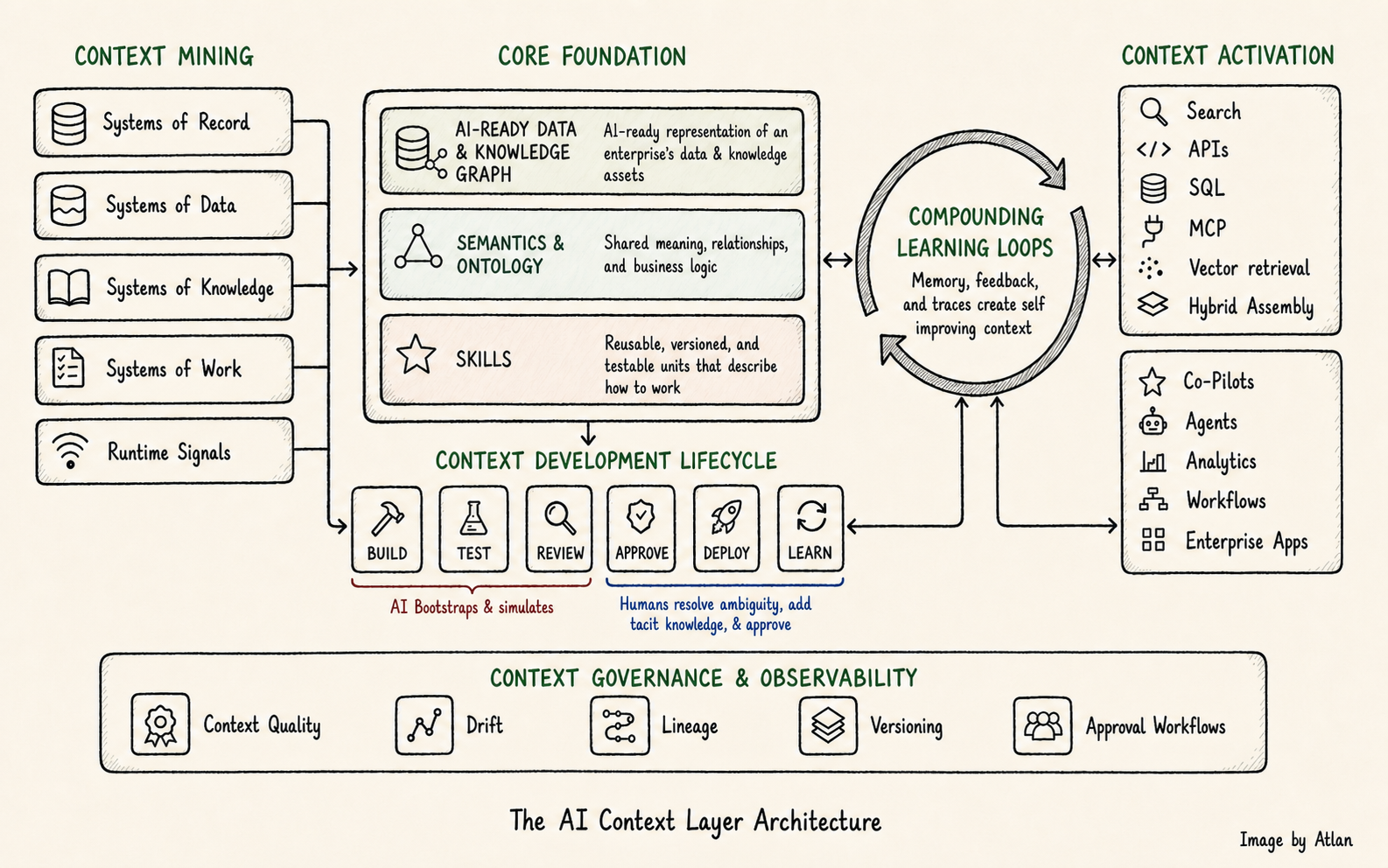
Jaffe: You’ve been one of the most cited voices on this topic, but the term “context layer” means different things to different people. Before we get into what Atlan is building, can you just ground us on the definition? What is context, actually?
Sankar: I always say, let’s forget the jargon and start with what context actually means. I think of it as three things: knowledge, expertise, and norms.
Let me illustrate with an example most people understand. Say you call a contact center and tell them your order was messed up and you want a refund. For an agent (human or AI) to handle that well, the first thing it needs is knowledge: who is this customer, what happened to their order, was the mistake ours or theirs? That’s the map of the business.
The second thing it needs is expertise: how do I triage competing issues? The customer mentioned social media, which triggers a de-escalation procedure. This is what companies call learning on the job.
And then there are norms: I’m not allowed to authorize more than $50 of a refund without escalating to my manager. Some norms are explicit. A lot are implicit. That’s where human judgment gets created.
“Performance is a function of intelligence and context. Cognitive intelligence only has about a 10% impact on job performance. Everything else is this context: the knowledge, and what they call learning on the job.”
Jaffe: That framing redefines the problem in a useful way. Anyone who’s used AI in an enterprise context has noticed that as the model improves, work often gets re-bottlenecked by the lack of different kinds of context. The missing knowledge, expertise, and norms get in the way.
Sankar: Exactly. And we saw it earlier than most, because we were trying to ship AI products ourselves. When we launched Atlan’s first AI features, this was three or four months after ChatGPT. We were probably among the first 20 or 30 companies globally to ship a real AI product. We could never get accuracy above 70%. And 70% was genuinely better than not having it. But it wasn’t anywhere close to the autonomous AI ecosystem we wanted to build.
What we realized was that the accuracy ceiling wasn’t a model problem but a context problem.
Why incumbents haven’t solved this
Jaffe: You might have expected the large pre-genAI incumbents to own this layer. They have existing data relationships, brands, distribution, products, and customers already using and storing their data inside, and huge balance sheets. The AI part is delivered like electricity from frontier labs. So you’d think they just wire it into their products and win.
Sankar: And our ability to move that fast came directly from living the problem. The only reason Atlan exists is because we built data platforms at scale before we built a product. We spent years running data teams for the United Nations, the World Bank, and large governments. We built India’s national data platform, which became the largest public sector data lake of its kind. We experienced, firsthand, how hard it is to share context across interdisciplinary teams where everyone speaks a different language and no one can see anyone else’s work.
The only reason we’ve grown as fast as we have is that we lived the problem.
What a real context layer does
Jaffe: Atlan came to market as a data catalog. You called it the third-generation catalog, built around active metadata. That product grew fast. But when generative AI arrived, you did something more ambitious than bolting on AI features. You basically rebuilt the fundamental premise of the product. Can you walk through what the context platform actually does today?
Sankar: The core insight was that our catalog was solving a human-consumption problem. It was designed to help data engineers and analysts find and trust data. But the future primary consumer of this context was going to be an AI agent. Agents have completely different requirements.
So the platform now works in three stages.
The first is context mining. We have our own agentic harness that reads across hundreds of connected systems: data warehouses, BI tools, code repositories, systems of record. It reverse engineers accurate context from all of them. I want to stress the word accurate here, because this is where a lot of people underestimate the problem. You can take tables and throw them into any large language model today and ask it to generate an ontology. It’ll actually look pretty good. The problem is that it won’t be accurate.
“You can throw tables into an LLM, and it’ll generate an ontology that looks pretty good. The problem is it’s not going to be accurate. We’ve built a context quality pipeline, similar to how you’d build a data quality pipeline.”
We’ve invested in making this deterministic. We read lineage, we read code, we track how metrics are used across systems, we see how your BI tools consume data. We build descriptions from verifiable sources, not inference. Then we can reverse-construct metrics, relationships, and eventually the ontology: the map of your business.
The second stage is embedding into agent development. Getting an agent live takes minutes. Getting it accurate enough to trust and actually ship takes months, because context engineering is genuinely hard. We embed into that development lifecycle so builders can pull from the context layer, test against it, and push learnings back.
The third is trace mining. Every agentic interaction is itself context. When a human overrides an AI decision, that override is information. We capture those traces (they’re big data now, at scale) and feed them back into the context layer. I’ll have customers say, “We launched this agent at 50% autonomy, and we want to take it to 90%. How do I do that?” You capture more traces of how humans are making decisions and overriding the system, and you improve your context over time. Every interaction makes the next one smarter.
“It takes five minutes to build an agent. It takes many months to give it the context you can actually trust and ship. We embed ourselves into that agent development lifecycle so that that gap closes.”
Where the context layer fits in the existing stack
Jaffe: The questions we got from the audience were quite sophisticated on this: the relationship to traditional metadata repositories, semantic graph systems, data lineage, and lakehouse governance. Where does the context layer sit relative to all of that?
Sankar: The way I’d frame it is that a context layer manages several types of context. The first is the ontology, the map of how things in your business connect. Customer is related to order, is related to contract, is related to renewal date. That’s what any AI agent needs to reason across the business, not just within a single system. The second is the semantic model: the metrics, measures, and dimensions associated with your data, the source of truth definitions, what counts as ARR versus what doesn’t. The third is the AI-ready data itself: descriptions, relationships, how to run a join, how to trust a number.
And then separately, there’s expertise and norms: skills, procedures, what people call agent operating procedures, the equivalent of standard operating procedures for agents.
As for where it sits relative to existing tooling: if you have a metadata catalog, we can pull from it. You don’t need to rip it out. The context layer sits above all of these systems, catalogs, data management, reference data, business process tools, and converts their contents into a single machine-readable interface that every agent in your stack can consume.
Jaffe: The coding agent analogy is useful here. Coding agents don’t only use your source code repository directly. They can use a knowledge graph built from that code, one that understands what each piece of code was for and how it relates to everything else. The agent is the consumer, not the human. The enterprise context layer is a similar concept, but applied to the whole company.
“Really good companies get better over time as they interact with more surfaces in the world. The context layer can become the core brain of the company as a learning system.”
The final frontier is human
Jaffe: You’ve been unusually transparent about Atlan’s own AI transformation. You have a whole site called Frontier documenting your experiments, including some that didn’t work. The one that got a lot of attention was telling your engineers they weren’t allowed to code anymore. What’s the real lesson there?
Sankar: The lesson is that the final frontier in becoming an AI-native company is human, not technical. All of us, especially if you’ve built expertise in something, have these fixed mental models about what we know how to do. And those models are exactly what you need to break.
I had a moment earlier this year where I realized I was still using AI as a way to improve my own work. I’d come up with something and ask AI to make it better. That’s a very natural first mode. But I wasn’t letting it replace my first move.
Then one day I said, just go do it. Go look at how comparable companies have positioned this, read our context, write the landing page. And it came back with something that was so good. And I remember having this moment of genuine insecurity. Positioning is one of the few things in my professional life where I thought I was genuinely top 1% in the world.
“In that moment, people have different responses. You fight, you flee, you freeze. But you can also choose to play and bring back childlike curiosity. What you choose to do in that moment is what changes.”
That moment of insecurity is what every individual and every team is going to go through. The companies that figure out AI-native operations aren’t winning on technology. They’re winning because they’ve found ways to get their teams to move through that moment and keep going.
The context infrastructure is genuinely buildable. What Atlan is building, and what a growing number of companies are starting to recognize they need, is tractable. The harder problem is the one Shankar describes: Getting people to let go of what they already know how to do. That’s where the gap between companies that get AI right and those that don’t will ultimately show up.
Editor’s note: Insight Partners has invested in Atlan.
The post The enterprise AI bottleneck is about context, not capability appeared first on Insight Partners.
]]>The post Behind the investment: Convex appeared first on Insight Partners.
]]>As AI agents become first-class participants in software development, we are seeing a new generation of infrastructure emerging to support both developers and the agents writing code alongside them. At Insight Partners, we’ve been closely tracking this shift for several years, investing in companies like E2B*, CrewAI*, Runware*, Fastino*, and Databricks*.
Databases and backends are an area we have followed closely since the early days of large language models. We have been looking for a platform that is easy enough for developers building AI applications today but designed for a future in which agents write more of the software, manage state, and run workflows autonomously.
Traditional backends assume an experienced engineer will assemble the stack and know where to add transactions, retries, cache invalidation, and synchronization. That assumption can become a liability when agents are writing more of the code.
Convex was built for what comes next.
A backend built for developers and agents
Convex brings the core components of a modern backend platform like database, server functions, real-time synchronization, workflows, search, and file storage into a single, unified TypeScript-native platform.
Instead of stitching together separate databases, APIs, queues, and synchronization services, developers and agents can express application logic directly in TypeScript. That means less glue code, fewer architectural decisions, and fewer places to make a plausible but costly mistake.
We view Convex’s reactive architecture as a good example of this. In a traditional stack, developers decide what data to fetch, when to refresh it, and how to keep every client in sync. Convex handles that automatically by tracking which queries depend on which data and pushing updates if and when that data changes. Mutations also run transactionally, helping applications remain consistent when multiple users or agents act at the same time.
These properties matter in two ways: first, they make Convex a strong platform for coding agents. One language, strong types, automatic feedback, and fewer moving parts help agents produce applications that work beyond the initial demo. Convex extends that advantage with integrations for major coding agents that allow them to inspect real deployments, surface errors, and verify their work as they build.
Second, Convex is well-suited to running agentic applications. Agents can read and write shared state, execute work concurrently, and use durable workflows that retry and resume after failures.
What’s ahead
After following and using Convex for some time, including for a fair number of weekend projects, we had the opportunity to meet the team last year.
Jamie Turner and James Cowling both came from Dropbox, where Jamie led storage and database engineering and James helped build its multi-exabyte, geo-distributed storage infrastructure. They brought that experience to a problem that is easy to underestimate: removing backend complexity without giving up correctness.
We came away convinced that the depth of the team matched the ambition of the product.
Convex has spent years building the underlying database and sync engine while fostering a passionate developer community. That work is now showing up in adoption, with more than 21,000 GitHub stars, nearly 500,000 developers, 2 million applications built, and over 1.2 million weekly npm downloads.
We believe Convex can become a foundational backend layer for a world in which software is increasingly built by developers and agents working together.
We are thrilled to lead Convex’s Series B and to partner with Jamie, James, and the entire Convex team as they make reliable backend architecture the default for developers and agents alike.
*Editor’s note: Insight Partners has invested in Convex, E2B, CrewAI, Runware, Fastino, and Databricks.
The post Behind the investment: Convex appeared first on Insight Partners.
]]>The post How Checkout.com became a global fintech leader appeared first on Insight Partners.
]]>It wasn’t long before he started spotting bugs in the global payments machine. In 2007, he founded NetMerchant, which allowed United States-based companies to make foreign currency payments into Europe. Two years later, the Swiss-born founder launched a second startup called Opus Payments, focused on the APAC market. It was Opus Payments that would eventually become Checkout.com.
Checkout.com was born in 2012. The payments platform makes it easy for merchants to trade, solving problems many incumbents ignored. Traditional payment providers relied on aging infrastructure, with fragmented systems and slow innovation cycles. Pousaz believed merchants needed a modern, full-stack payments platform built for the internet economy.
For almost a decade, Pousaz bootstrapped Checkout.com, expanding his London-based company into 140 countries. “We always wanted to be global,” he says. “We have been granted licenses in every major market where we operate.”
“So many people told us it was impossible”
A global outlook is essential to companies that aren’t based in the U.S., Pousaz explains: “We had to go out and build a lot of geographies…to follow our customers.”
Once established across the globe, Checkout expanded into the U.S., opening offices in New York in 2022, then San Francisco and Atlanta in 2025. It’s now the company’s fastest-growing territory, with revenues up 80% year over year — but no one region, or customer, dominates. This diversification helps ensure resilience. “We’re sitting on a mature business,” he says.
While many rivals were built servicing a single large customer, Checkout has never been beholden to a single entity. “We were able to build for the ecosystem,” he says.
Today, Checkout.com powers payments for some of the world’s largest digital businesses, including Uber, Microsoft, Spotify, eBay, and Trip.com.
Pousaz candidly admits that Checkout’s growth has outstripped market expectations. “So many people told us it was impossible,” he says. “People told us, ‘You’re never going to be licensed in the [United Kingdom],’ and yet we’re one of the first payment licenses in the U.K.”
“Then people were telling us, ‘You’re never going to sign a Silicon Valley company,’ and we ended up winning Netflix.”
In 2018, Pousaz decided it was time to seek an investor to help him take the business to the next level. “Not because we needed money,” says Pousaz. “I was really looking for expertise, so my equation of value at the time…was that I was really looking for somebody who was an operator who would know how to run and build a business.”
After meeting dozens of potential investors, Insight Partners stood out, says Pousaz. “They have a business-builder DNA, they know how to operate businesses at scale, they had their Onsite team, and we were very keen on this.” Insight Onsite is a team of 100+ in-house experts that help Insight portfolio companies scale and grow.
In May 2019, Checkout.com raised its $230M Series A with Insight; at the time, this was Europe’s largest fintech Series A round. In June 2020, Checkout.com closed a further $150M Series B funding round, in which Insight also participated.
Checkout’s fundraising wasn’t core to business growth; it was an exercise in ensuring stability. Pousaz explains: “We’re doing the payments, so we’re basically in the flow of the revenue, and our balance sheet was essentially the sum of our retained earnings. Adding capital was mostly to shore up our balance sheet and become financially stronger than we would get organically.”
Subsequent funding rounds — a $450M Series C in 2021 and a $1B Series D in 2022, which Insight also participated in — helped sustain Checkout’s growth trajectory and solidified its reputation as one of the fintech sector’s greatest success stories.
Scale up your career: See all open roles at Checkout.com.
The investor POV
“He’s a special founder. There’s just an intense personality…and he had a clear vision for how he could keep compounding the business for a really long time.”
Managing Director Deven Parekh had heard of Checkout.com before they met, but a lunch with Pousaz won him over. Pousaz had bootstrapped the business to profitability — “That’s rare,” says Parekh — and had built it on a counterintuitive thesis. While rivals went after small clients first, Pousaz pursued bigger merchants on deliberately thin margins, on the basis that if he could make the economics work there, he could make them work anywhere. The goal was always global infrastructure for the enterprise rather than dependence on any single anchor customer.
“[It was] a next-generation tech stack in an industry where there were tons of older tech stacks and a total addressable market that is unlimited,” says Parekh. “He had a clear vision.”
According to Parekh, Checkout is a stellar example of compounding. “That’s the beauty of the business,” he explains. “If you serve markets that are growing at 30% and you keep your customers happy, you can grow at 30%…That’s what I like about the payments business model…that’s simple business but hard to execute.”
The relationship was founded on mutual respect. “Deven was the first person who really shook my hand and said, ‘Let’s do this,’” says Pousaz. “We’ve had an amazing relationship ever since.”
Pousaz stresses the value of having an investor who consistently shows up. “Deven is somebody who’s been 20 years in technology, somebody who was always available. He’s incredibly responsive, and somebody who gave me time and really cared about the business early on.”
Financial firepower and sector expertise
Insight Partners’ initial investment came at an inflection point. Checkout.com had already proven product-market fit, but now it needed a repeatable playbook to accelerate its global expansion.
Insight’s pitch was direct. “I get your story. We understand these types of businesses. You bootstrapped it, and now we’re going to the next gen, where we’re going to have to hire next-gen talent. We’re going to have to scale go-to-market, and it can’t just be you running around doing everything,” recalls Parekh. “That’s what we’re good at doing.”
Insight’s Onsite team came to London to support Checkout.com every quarter. “We used Onsite mostly for two things: go-to-market strategies and marketing,” explains Pousaz.
“When we raised our Series A, we had never spent a single dollar on marketing. We didn’t even have a marketing team.”
Operating Partner Gary Survis took the lead. Digging in for 1,000+ hours over the first few years of the relationship, Survis worked across nearly every dimension of Checkout.com’s growth — from sitting on hiring panels for early marketing employees to leading brand and messaging workshops that brought together the company’s full executive team. “What started as ‘We have no marketing function’ became something much bigger over time. The needs kept evolving as the company grew, and so did the work. That’s what a long-term partnership looks like.”
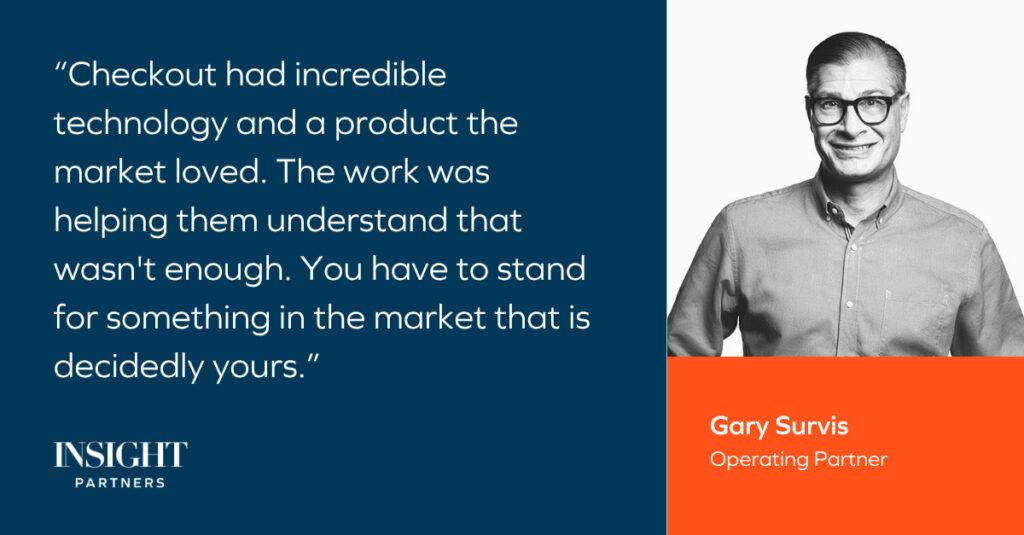
“[Survis has] been instrumental in the hiring,” says Pousaz. “[Onsite has] helped build the strategy; they’ve really helped us build the thing from the ground up.”
On the go-to-market side, it was less about reinvention and more “fine-tuning,” says Pousaz. “Sharing best practices of what [Onsite] sees in other companies.”
In the early years after the investment, Pousaz and Parekh spoke almost every week. “We would have a regular catch-up on Sunday morning,” reflects Pousaz. “He likes to walk and have a phone call and catch up on how the business is doing today.”
The depth and breadth of Parekh’s experience helping technology companies to scale made him the ideal sounding board for a fast-growing company. “The best CEOs are always looking for perspectives and always looking for challenge,” says Pousaz.
“We make our own decisions, we have our own ideas, but obviously we like to hear from other smart people, and [Deven] is definitely one of the people I always go back to.”
Pousaz and Parekh have worked together to navigate the ups and downs of the last eight years. This has created an unshakeable bond. “I will always be loyal to Deven,” says Pousaz. “I’m loyal to all my investors, but Deven was the first one. The same way you remember your first boss, you always remember your first investor.”
AI, agentic commerce, and the human operating system
Pousaz shows no sign of slowing down. “We’re committed to building the largest fintech company in the world,” he says.
Innovation will be crucial to this market dominance. “Velocity continues to be the number one priority,” he says.
“Our job is to bring innovation to our customers faster than they would get it elsewhere today.”
Pousaz is using AI workflows to accelerate technological change across the company. “Turning data scientists into Agents,” he explains. “Instead of having these very smart and expensive data scientists, but actually a limited output, how do you actually really scale that horizontally, leveraging AI?”
Despite being “positive” on the net impact of AI tools, Pousaz remains committed to “the human operating system.” Checkout’s headcount has increased almost 6x since that first investment, to over 2,000 people.
“We think that a company is only as good as the people, and having the best people here, having high human capital density, is the best way for us to be excited to work together, creating value together, and it’s a key priority for me as a CEO.”
Payments is a dynamic sector, and opportunities abound. Agentic commerce is becoming a real growth area for the business, Pousaz reveals, whereby AI Agents transact on your behalf. The technology is still in flux, so Checkout is building out frameworks to suit every possible scenario.
“When agentic commerce starts to take hold, when consumers are actually transacting through Agents, merchants are going to need infrastructure that can handle that,” explains Pousaz. “Checkout.com is built for that. We’re focused on making sure our merchants are ready for however this channel develops.”
“You’re always four years out”
Checkout.com has done the seemingly impossible: The world’s biggest merchants trust its platform to handle their revenue. “You’ve passed the highest level of procurement and compliance internally at any company, so you’re in a good place to go and sell additional services,” says Pousaz.
Parekh agrees that there is a long road ahead. “They’ve been able to successfully transition from a regional business to a truly global business. And there’s a huge amount of customers that are still sitting with legacy processors where Checkout can offer a next-gen platform and best-in-class customer service,” he says.
“There’s just so much business still to go get, and I think they’re really well positioned to go get it, because they’re investing heavily in the tech stack.”
The company’s future relies on Checkout’s transition from a single-product company to a true multiproduct platform, says Pousaz. Checkout could sell multiple things to its customers: “Everything from treasury, to card issuance, to payouts, to modern corporate banking.”
“Most fintechs have started in a corner of fintech or with a very pure play approach,” he continues. “But over time, fintechs are evolving to become true multi-product companies, and it’s going to be important for us to do so as well, and that’s where I’m really spending most of my time.”
That long-range thinking extends to agentic commerce as many major tech platforms launch their own protocols. “We’ve built a lot of frameworks already. When something is actually becoming the winner, or will translate into shoppers using Agents, the merchants can basically leverage Checkout to process those transactions.” In June, Checkout announced it had been selected by Microsoft to support digital products across EMEA, including Xbox and Microsoft 365.
“As a CEO today, what I’m working on has no impact on 2026 and probably very little impact on 2027 already, because so much of that machine is already in motion,” says Pousaz.
“What I’m working on today is really what’s going to happen in 2028 and 2029. You’re always four years out.”
Pousaz is energized by what the future holds. “I’ve been a CEO of this company for 15 years now, and I’m only 44, so I have another 20 to 30 years in me. I just love my work, I love my team, and we’re clearly ambitious,” he says.
“We have an athlete mindset at Checkout that is ingrained in everything that we do. It’s really about never being comfortable, being rigorous in planning, wanting to stretch the goals. Whatever you achieve, you’ll want to do more. So yes, we’re a very ambitious company.”
*Editor’s note: Insight Partners has invested in Checkout.com
The post How Checkout.com became a global fintech leader appeared first on Insight Partners.
]]>The post The Next Stack: The future of AI in cybersecurity appeared first on Insight Partners.
]]>We believe cybersecurity will follow the broader AI trajectory as model capabilities reach the point where they can independently complete a full day of human work, and as the focus of AI advancement shifts from software to labor.
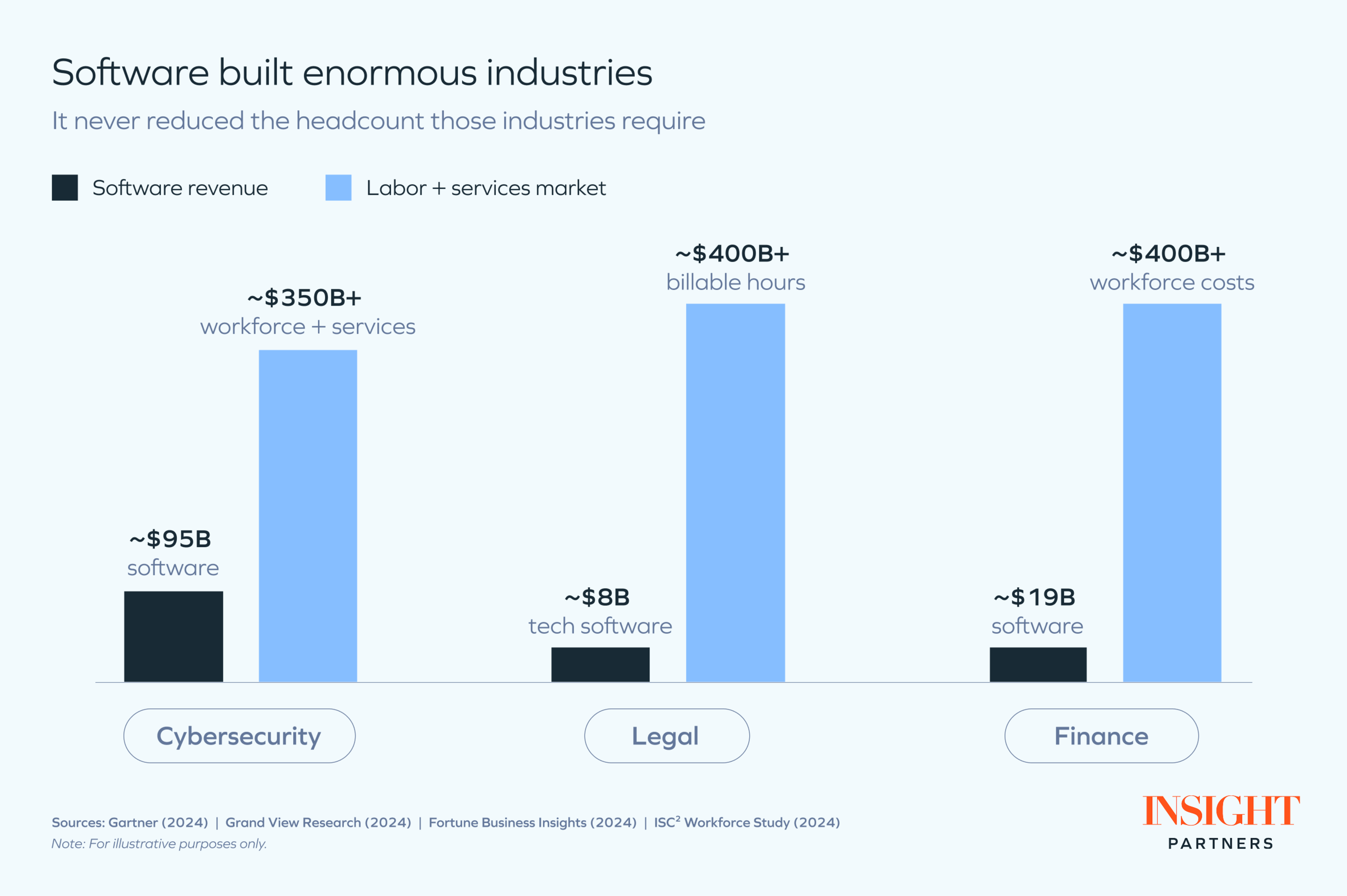
The reality is that CISOs need to adopt an AI-native mindset, using AI to discover and prioritize remediation of attack paths and exposures, and to automate cybersecurity workflows and response procedures to move at ‘machine speed.’ We believe the benefits of this shift will not be evenly distributed across vendors. Deeply embedded control points — for example, for the endpoint, identity, certificate infrastructure — remain defensible. However, analytics, reporting, and workflow products face a greater risk of disruption as enterprises explore the opportunity to build their own.
As interfaces consolidate and shift toward headless architectures, we expect the management plane and domain-specific agents to offer the greatest opportunity for startups and ScaleUps — and where defensibility will stem from network effects, proprietary data, and brand rather than single features.
From one enterprise cybersecurity leader Insight Partners recently spoke to, the sentiment is echoed across the industry:
“The opportunity is to transform from a manager of a set of tools, to a manager of agents… you go from analyst to engineer. Otherwise you’re looking for another job.”
Significant AI trends impacting cybersecurity
We believe these three specific developments in AI have a significant impact on the future operating model for cybersecurity.
1. Agent and app building
Individuals can now build applications and agents themselves, which includes the security team. Insight Partners recently spoke to a Deputy CISO who has five agents working for them around the clock. This is a huge accelerator for cybersecurity teams and also may lead some CISOs to question the value delivered by certain features in vendor offerings. Why buy that product feature when you can easily build it yourself and tailor it to your use case?
Why buy that product feature when you can easily build it yourself and tailor it to your use case?
No one is likely to vibe code a CrowdStrike. There are network effects and data moats that mean that companies like CrowdStrike and SentinelOne* should continue to have an advantage over things you can build yourself today for that control point. But there are features and workflows that currently sit within code in vendor products that might be advantageous for enterprises to refactor themselves, highly customized to their individual operating models.
This raises three questions for security leaders and builders in the space.
- Which workflows will security teams delegate to agents? And therefore, how do the security team members’ roles evolve?
- Which product features will become more or less important in a world where AI is enabling the development of fully tailored software?
- Where will security teams build those agents and applications? And how much of it will be full build versus extending platform agent-builder capabilities, or simply buying into an agent-native vendor ecosystem?
To attempt to answer these questions, we first need to discuss the other trends driving change in the industry.
2. The shift to headless SaaS
As agent adoption accelerates, software is becoming increasingly headless. In April 2026, Marc Benioff announced a headless Salesforce, declaring “Our API is the UI.” Even before that, we’d heard from several founders whose teams haven’t logged into Salesforce for months. Everything is driven by automation and agents.
Cybersecurity is seeing a shift in that direction as well. Sysdig* can be used as a headless cloud security product. Trench has built a headless SecOps product. And others have built Model Context Protocol (MCP) servers to enable agents to pull data from their solutions.
Beyond the vendors, Notion’s security team built an agent called ‘Scruff’ that runs autonomous incident investigations. They no longer log in to Wiz*, CrowdStrike, or Scanner through a browser as part of those workflows. Instead, Scruff pulls the data via API and MCP for the security team to act on.
We’ve spoken with other CISOs in our network, including one who has built connectors from Claude to Wiz, Azure, and other security tools to surface data for analysis through the Claude interface. It’s clear that the days of multiple UIs are ending. We are heading toward a world where the API is the UI for most products. What remains is the single management interface that allows the security teams to visualize and interact with their increasingly headless security stack.
In a world where the API is the UI, what becomes the management interface?
3. Expanding cybersecurity capabilities of frontier models
Finally, we get to the frontier labs themselves, the most active in cybersecurity being Anthropic*, OpenAI*, and Google. What role will the frontier labs have in the future cybersecurity stack?
Many cybersecurity capabilities — both vendor-led and custom-built — will leverage models from the frontier labs to sift through increasing volumes of data and uncover novel trends and attack patterns. But there’s a more direct threat to many of the startups in the ecosystem today: frontier labs encroaching on their domain.
Frontier labs could compete directly by releasing security-specific capabilities — Claude Code Security and Codex Security from OpenAI are early examples — or indirectly, by lowering the bar for security teams to build their own custom tools or agentic workflows. Platform companies could accelerate both paths further by embedding these capabilities into their existing products. Most recently, at the time of writing, Cisco Cloud Control includes a marketplace for agents and applications built on the platform. The platform itself is using OpenAI Codex.
Going back to the theme of AI shifting from software to workforce, there is an opportunity for the frontier labs to become the center of work for cybersecurity teams. What remains are the solutions that provide the data, context, and initial correlation and analysis outside the reach of the frontier labs. Revisiting our examples from before — SentinelOne and CrowdStrike — these solutions are deeply embedded into the endpoint and provide rich telemetry and initial blocking and tackling of direct threats on the devices they protect.
Solutions like Keeper*, Delinea*, and Keyfactor* that provide identity, authentication, and certificate infrastructure are also likely to be at lower risk of disruption. These are companies with deep technical expertise that are the infrastructure and control points of the cybersecurity environment. However, anything that is essentially an analytics, reporting, or workflow product could be at greater risk of disruption.
As a side note, we should not ignore the potential role of small language models (SLMs) and open-source models in this future state. We have seen increasing interest in SLMs tailored for specific use cases owing to the fact that they are typically more efficient to run and can be tailored to produce above-par results for specific tasks, and trained on the context of the organization and use case.
Open-source models also provide a potentially cheaper option (in terms of inference costs), but with the leading open-source models coming from China, this raises questions as to how secure those models might be and ultimately to what extent enterprises can effectively secure them if that is indeed a requirement. Solutions like Skyflow* that provide data protection capabilities during runtime are an example of how enterprises can stay secure and compliant whilst making use of these potentially riskier models.
The Next Stack for cybersecurity
The Next Stack is built for agents from the ground up. That means a strong data foundation, AI-first architecture, and technology that agents can actually access through open interfaces.
We’ve alluded to these already, but we can separate the Next Stack into three layers, as shown in the diagram below.
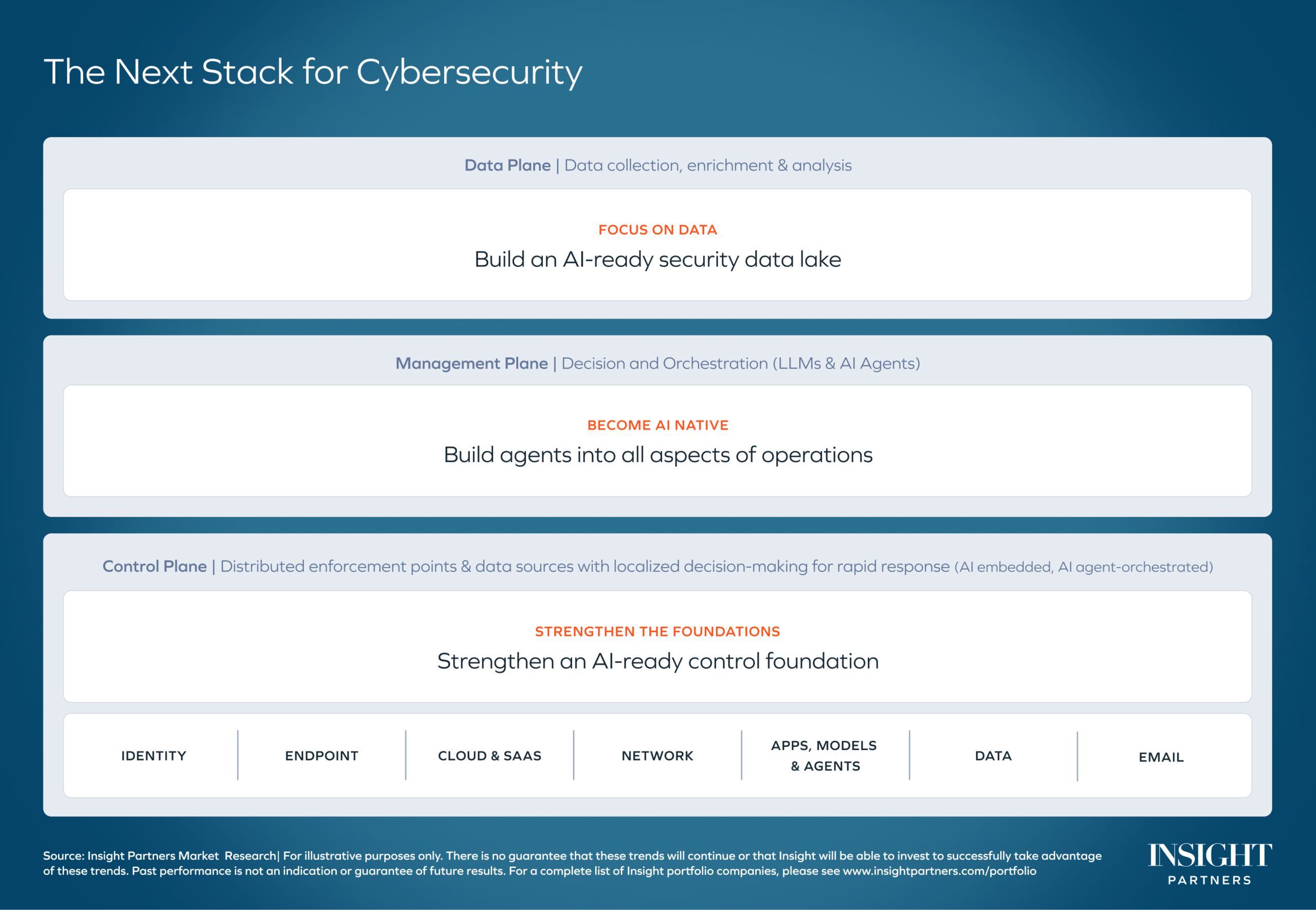
The three planes can then be described as follows:
The data plane
The data substrate where all data relevant for the cybersecurity operating model is stored and analyzed. This will typically be implemented through a security data pipeline (e.g., Databahn) and a data lake (e.g., Databricks*).
The management plane
The orchestration and reporting layer of the environment. This is where the SecOps team operates, building and managing agents that orchestrate across the security control environment, and managing the centralized context layer for those agents. We anticipate the management interface for SecOps teams converging into a single interface. The management plane extends down to the control plane through the definition of domain-specific agents described below.
The control plane
The solutions on the front line that provide the control points in the environment across the typical security domains. Every domain itself is operated by domain-specific agents that are orchestrated by the management plane to enforce consistent policy across the enterprise. We also introduce defensive and offensive agents — essentially the red-team/blue-team members. The control points themselves will be implemented using the technologies we know well today – firewalls, Endpoint Detection & Response (EDR) capabilities, Identity Providers (IdPs), cloud-native application protection platforms (CNAPPs), email security solutions — but in an agent-native, headless architecture.
An example of what this could look like conceptually in an enterprise is shown in the diagram below.
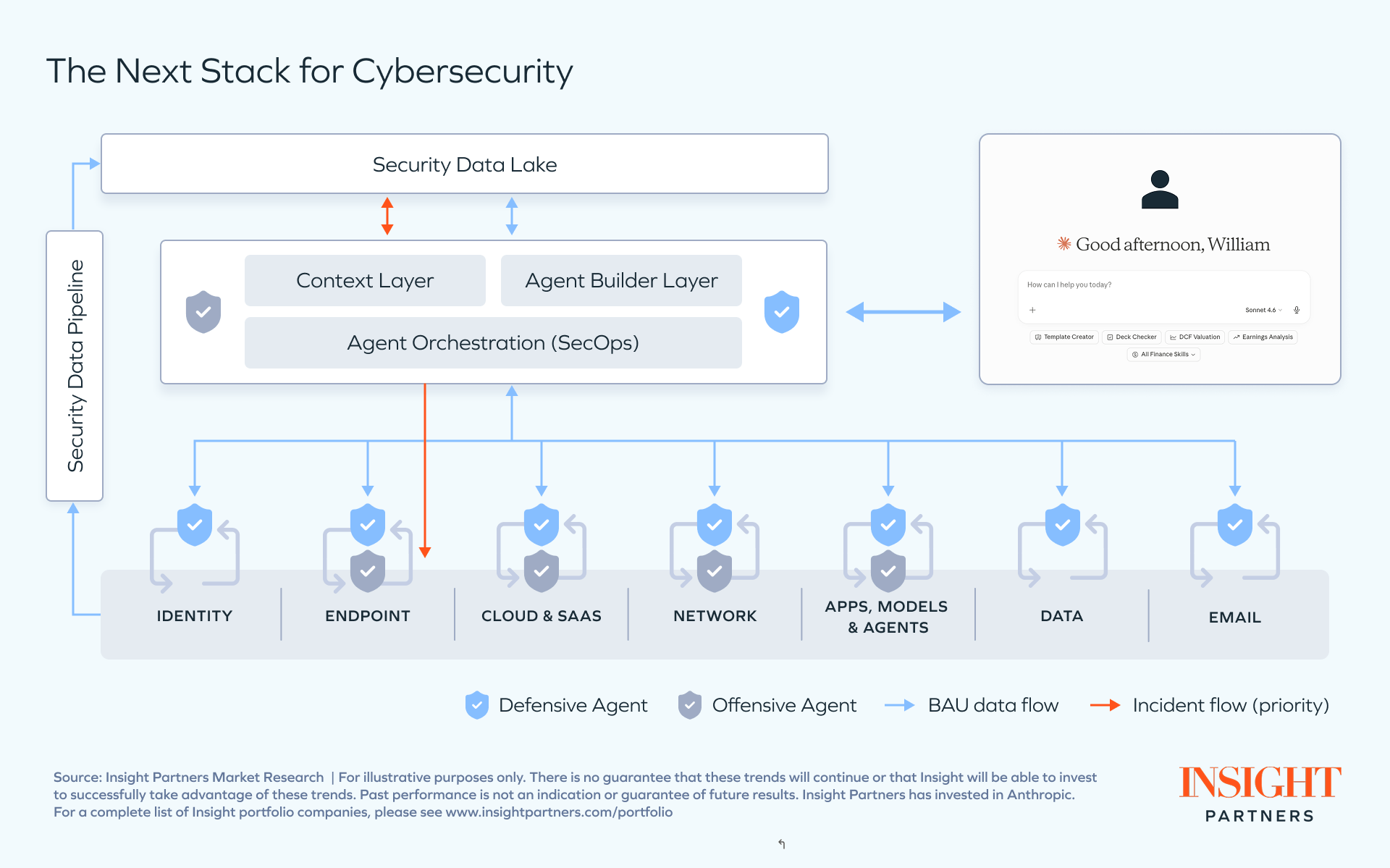
In the future cybersecurity operating model, the role of security operations will shift toward building, managing, and coordinating fleets of orchestration agents that ensure consistent implementation and operation of policy across the stack, while coordinating changes based on regulations and risk profile, almost like a governance, risk, and compliance (GRC) function, and domain-specific agents. Domain-specific agents require deep subject-matter expertise to ensure that the control points within that domain function effectively, and those same experts will be expected to step in to manually triage where things break down.
Questions for innovators in cybersecurity
So what does this mean for cybersecurity innovation? Let’s attempt to answer the questions presented earlier in this article.
Which workflows will security teams delegate to agents?
And, how does the role of those security team members evolve?
Our perspective is that, like all enterprise work, the first workflows to be automated will be those that are repetitive and analysis-heavy: alert triage, threat report summarization, and access reviews. That is already happening in many enterprises.
Beyond that, we expect to see more complex workflows shifting to agentic capabilities — architecture reviews, offensive security testing, threat hunting — capabilities which are already accessible through innovative startups today.
Ultimately, as more workflows are handed over to agents, the role of the security team is elevated as they become the in-house experts tasked with building and training those agents — along with agent skills — to be able to operate within the unique enterprise environment, and also to act as a manager of agents, ensuring that those agents are executing as they should. We also expect agents to continue to require human oversight and a human-in-the-loop, particularly for critical decisions where there is a potential risk of disruption or impact on security posture.
Which product features will become more or less important in a world where AI is enabling the development of fully tailored software?
As frontier labs enable the democratization of bespoke interfaces and agent workflows, we may see enterprises building their own human interfaces in place of the previously singular dashboards across multiple products. We may also see the development of bespoke analysis and workflow execution agents — and although not every organization will want to build their own, this does mean that the bar for what is considered a value-add workflow in a product is significantly higher.
What becomes more important are some of the product moats around network effects, proprietary data that cannot be sourced from within an enterprise, and brand (there is unlikely to be appetite to trust a home-grown solution to block highly sophisticated attacks at the perimeter of the network).
Where will security teams build those agents and applications?
And how much of it will be full build versus extending platform agent-builder capabilities, or simply buying into an agent-native vendor ecosystem?
We continue to see platform players releasing agent-builder capabilities, including Microsoft’s Security Copilot custom agents, Palo Alto Networks’ AgentiX, CrowdStrike’s Charlotte AI AgentWorks, and, most recently, Cisco’s Cloud Control Studio. These platforms have also developed marketplaces enabling customers to leverage third-party agents and applications.
Few enterprises are building full-suite capabilities on these platforms today, but that could change. Builder platforms make it easier to create applications and agents, and crucially, to integrate them into existing IT and security stacks. That integration advantage may ultimately make building within a platform more practical than using a third-party agent builder, in which teams would otherwise have to set up those connections manually.
As with previous technology shifts, we expect a balance of build versus buy. Some enterprises will lack the skills or resources to build the best-of-breed agent capabilities needed, or simply choose to buy products with agent-native capabilities and integrate them as part of an ecosystem. We also expect many vendors to refactor their solutions into agent marketplace offerings, ensuring their latest product capabilities are available across various platforms.
In a world where the API is the UI, what becomes the management interface?
One thing is clear: We do expect to see a consolidation of the many security interfaces available today into a singular interface. However, whether that management interface is custom-built or built on top of a technology platform remains to be seen. We expect to see a mixture of both formats.
What is the role of the frontier labs in the future operating model?
The frontier labs will have a critical role in the future cybersecurity operating model. That is, both as the models that will underpin the agentic infrastructure and, in some cases, as an interface to the security stack. We believe there will be a mixture of security teams that choose to leverage their core technology products as a control plane for agents in the security stack, whilst others will opt for end-user-developed agent applications built through frontier lab solutions, connecting the security stack back to those desktop applications using custom or pre-built connectors.
As noted earlier in the article, there is potential to adopt SLMs and open-source models that can be fine-tuned in the enterprise environment and operated at a much lower price point. However, we are early in adopting open-source models for cybersecurity. Today, most use cases are implemented with frontier models.
What this means for startups and ScaleUps
Startups and ScaleUps need to clearly understand where they fit within the Next Stack, and which features are truly defensible versus those that will be consumed through custom-built solutions. Where there is defensibility, the goal is then to determine how that capability should be integrated into the future agent-centric ecosystem, either as an independent product or as part of a platform-delivered marketplace.
Looking across the Next Stack in more detail:
- If you’re in the control plane, you need to ensure your services are easily accessible and consumable by AI agents. We believe the companies that win here will not only have the best technology but also integrate seamlessly into the agent-native ecosystem.
- In the data plane, the data lake itself is likely for the incumbents, but we’re seeing a range of innovative startups that provide quick data parsing and data search that may act as a shim to accelerate interactions between the data substrate itself and the agents accessing that — effectively the data pipeline between the agents and the data lake.
- The management plane and the extension of this down to the control plane through domain-specific agents is where we’ll likely see the most disruption and opportunity for innovative startups. Focusing on being a best-of-breed agentic harness and orchestration solution that drives more consistent, accurate, and faster outcomes beyond what enterprises can develop themselves, either independently or with third-party service providers, will ensure ongoing relevance in this agent-native Next Stack.
We are seeing unprecedented technological change driven by advances in AI, which continues to impact every aspect of how work is done – including in cybersecurity – and we are excited to meet with founders building for this agent-native world.
*Editor’s note: This post contains forward-looking statements and predictions regarding the future of AI. These statements are based on our current expectations and assumptions, and actual results may differ materially from those expressed or implied in these statements. The information provided in this post is for informational purposes only and does not constitute financial, investment, or professional advice. This post should not be considered as a recommendation to buy, sell, or hold any particular investment or security. Investments in AI and related technologies involve inherent risks, and past performance is not indicative of future results.
Insight Partners has invested in Anthropic, Databricks, Delinea, Keeper, Keyfactor, OpenAI, SentinelOne, Sysdig, Skyflow, and Wiz.
Quotes in this article have been sourced from industry conversations and given with permission.
The post The Next Stack: The future of AI in cybersecurity appeared first on Insight Partners.
]]>The post Way Security wants to rebuild the foundation of enterprise identity appeared first on Insight Partners.
]]>“AI did not rewrite the laws of security physics,” says Barishev. “Whatever gaps or lags in maturity have existed across organizations have now just been amplified by the velocity that AI introduces.”
One such gap AI has exposed is in identity and access management (IAM), which ensures that the right people have access to the right IT resources, for the right reasons, at the right time.
The problem, as Barishev sees it, is that most enterprise identity infrastructure is patchwork: point solutions bolted together, human resources information systems and identity providers with incomplete records, and, now, more and more non-human identities sprawling without clear ownership or a system of record. Enterprises are trying to use AI solutions to automate without addressing what’s broken underneath.
“Everything in identity today is built on a foundation that’s around 20 to 30 years old,” says Barishev. “Those technologies can no longer really hold the modern enterprise infrastructure together.” With Way Security, Barishev and CTO Yonatan Rosenberg want to fix that foundation and rebuild identity infrastructure for the AI age.
“The primary pain we’re solving is, how can we enable enterprise identity management around the existing complexity that reality brings us?”
Identity infrastructure hasn’t kept up
Way Security was born out of the founders’ frustration. Both Barishev and Rosenberg have spent most of their careers leading security teams at large companies, including together at Sygnia, and have grown increasingly discontented with how identity infrastructure is falling behind the pace of technological change.
“We had so much internal frustration,” says Barishev. “We rely so much on manual labor, just throwing humans at this problem space. And we were so fed up with this reality where for every dollar we spent on software, we’re spending three to five bucks on just the enablement of those solutions.”
After a year in stealth, Way Security launched in July 2026, with funding from Insight Partners and Glilot Capital.
Barishev’s previous role was running the security team at Fireblocks, a digital asset infrastructure company, which has secured over $10T in digital asset transactions for more than 2,400 institutional clients. The role shaped his perspective on what good security infrastructure should look like.
“We had the world’s leading adversaries breathing down our necks.”
“The primary takeaway I had from my experience over there is, how can you have a pragmatic approach to having security where business enablement is at its core?” says Barishev. “You’re building infrastructure that can scale and be pliable enough on one end, but at the same time enabl[ing] the velocity with which a modern organization should be able to move.”
No HR for AI Agents
IAM has always been one of the central pillars of enterprise security, and for good reason.
“At the epicenter of every single breach in history, there was always the theme of identity, because identities are the catalysts of access,” says Barishev. “The main principles of security in the age of AI have not changed…It’s still all about how adversaries can compromise identities as fast as possible.”
What has changed is the speed at which that can happen, and the fact that a growing number of those identities are non-human, both operating within the organization and attacking it from without.
A big part of the difficulty AI introduces is governance and figuring out the scope of its agency. Human employees have defined roles, responsibilities, and managers, and they sit within an organizational structure that determines what they should and shouldn’t have access to. AI doesn’t yet have that structure.
“There is no HR system for Agents,” says Barishev. “The main challenge we’ll see in the coming years is…how can we actually have a well-defined scope of what’s that purpose of that particular AI Agent…[and] seeing how we can have predictability into its behavior.”
For Barishev, the solution lies in treating an Agent as just another employee.
“Whatever internal governance structure you have so far, you’re not supposed to reinvent it for the age of AI. You just need to apply it in an appropriate way for this new animal you now need to deal with.”
“You need to fight fire with fire”
Security has a fundamental asymmetry. The defender needs to secure every single vector; the attacker only needs to find one weak link. AI has made this even more unbalanced because it can now happen at machine speed.
For Barishev, the answer is making sure security can match the velocity of AI, both in how enterprises defend themselves and in how security products are built.
“You need to fight fire with fire,” says Barishev. “The same way AI is being utilized to enable innovation, enable velocity, enable businesses, we need to do the same thing and apply it for the enablement of everything in security, everything in infrastructure.”
“We need to basically place as many hurdles as possible, as many guardrails as possible, applying the concept of defense in depth…to basically demotivate the adversary.”
Building the new perimeter of the enterprise
Barishev and Rosenberg are applying that principle to building Way Security. Rebuilding identity infrastructure from the ground up is an ambitious engineering challenge, and the incumbents in this space — Microsoft, SailPoint, Saviynt, and CyberArk — have decades of engineering work behind their solutions.
“I don’t think that we could have enabled technologically what we do as Way without having AI as a catalyst for it,” says Barishev. “If we want to have the ability to enable these giants and create a path for them and for the industry itself into the age of AI, there’s a lot of engineering work that comes into it.”
“People won’t be waiting five years for us to ship whatever we build. We need to do this now.”
Looking ahead, Barishev thinks the future of AI in security hinges on how the industry governs it.
“If we’re able to, as an industry, standardize around how we govern AI, how we secure AI, how we apply the basic principles of identity and access management to it…we’ll be in a great state, because identity is, was, and will be the actual perimeter of the enterprise.”
And the plan is for Way Security to play a central role in that future.
*Note: Insight Partners has invested in Way Security.
The post Way Security wants to rebuild the foundation of enterprise identity appeared first on Insight Partners.
]]>The post How Assured is building the automation layer for healthcare administration appeared first on Insight Partners.
]]>The hurdle was verifying clinicians’ credentials. “It routinely took months, not because the work was overly complex, but it was very error-prone, manual, and handled by armies of people,” says Krishnamurthy. “And so this ultimately leads to tons and tons of costly delays.”
They soon realized they weren’t the only ones experiencing this. The problem was decades old and affected much of the healthcare industry.
After Dawn Health was acquired in late 2023, the pair founded Assured the following year to build the AI-powered credentialing infrastructure they had always wished for and finally cut that metric down.
“We really think that by leading with technology, we can actually solve these problems at the source and deliver differentiated outcomes.”
Less than two years later, Assured has raised a $6M seed round, is processing tens of thousands of provider enrollments, and is growing 30% month over month.
The back office crisis in healthcare
Most people outside healthcare don’t think much about provider credentialing, which is the process of verifying a clinician’s credentials, getting them licensed, and enrolling them with insurance payers. But for healthcare organizations, it’s one of the biggest bottlenecks in scaling. And it causes many challenges downstream.
It can take between 60 and 90 days of manual work to verify one clinician. State medical boards need to verify education and training. Employers have to confirm employment history. Each state has different licensing requirements. And every insurance payer has unique credentialing forms and enrollment processes.
While this process is crawling along, clinicians can sit idle, healthcare organizations lose hundreds of thousands of dollars in revenue per provider, and patients can face months-long waits for care.
“The reason why these processes in healthcare are so slow is that the healthcare back office runs on tons and tons of disconnected systems [and] repetitive manual work,” says Krishnamurthy. “The world of the healthcare back office is filled with parsing of data, filling out forms, sending emails, [and] making phone calls.”
Assured uses AI to automate all of these processes, helping healthcare companies scale their provider network and helping providers see patients faster.
AI credentialing for providers
The platform uses machine learning for data cleanup and mapping, and models fine-tuned to run healthcare credentialing workflows. Its Agents can navigate web portals, adapt to changing state board requirements, verify credentials across more than 2,000 primary sources in parallel, and orchestrate multi-step processes spanning weeks across dozens of concurrent applications.
It means that Assured can fully credential a provider in two business days, compared to the typical timeframe of two to four months, and, on the payer enrollment front, get most providers in-network 15 days faster.
“Our customers, they care about very specific things,” says Krishnamurthy. “[T]hey care about how quickly they can get their providers ready to see patients. And so we tell them, ‘You know what? If you adopt our solution, you will be able to have your providers ready to see patients meaningfully faster than any other solution out there.’”
Assured already works with more than 100 customers, including digital health companies like Blossom Health and Tono Health.
Owning the whole workflow
However, for Krishnamurthy, the opportunity extends beyond credentialing. “We think of successful AI-driven products in healthcare as ones that do not just handle specific tasks but actually own entire workflows,” he says.
“It’s not enough for our solution to exist in its own silo. We must deeply integrate with our customers’ workflows to make a meaningful impact.”
Licensing depends on primary source verification, which depends on gathering the right documentation, which needs to be formatted differently for each payer. Assured handles these interdependencies, connecting to Salesforce and customers’ existing electronic medical records and applicant tracking systems.
The platform can track license expirations, automate state-by-state applications and renewals, manage payer-specific requirements, and maintain audit-ready documentation, while providing real-time visibility into where each provider sits in the pipeline.
“[W]e are really building an orchestration system here that can handle end-to-end workflows instead of just one single task…There are always inputs and outputs that need to be handled at the same time. And so for us to truly have a differentiated and meaningful solution in this space, we need to solve multiple problems at once,” Krishnamurthy explains.
Aiming to make healthcare infrastructure invisible
Right now, Assured has humans in the loop, checking that the data is correct and monitoring the output of the Agents. But the long-term vision is fully autonomous Agents, while keeping quality high.
“Especially in healthcare, it’s not just speed that really matters; it’s reliability as well,” says Krishnamurthy. “[I]t’s incredibly important, especially as we build solutions that scale with technology and not people, to ensure that the technology we’re building is maintaining the highest level of accuracy possible.”
Krishnamurthy and Shivkumar imagine a future where requesting a new license, enrollment, or credentialing packet is as easy as ordering on Amazon. It is a world where provider operations are largely invisible, where the limit to the growth of healthcare is patient demand, not paperwork.
“[W]e really believe that no matter how much clinical innovation occurs, access to quality care cannot scale without solving operational workflows,” says Krishnamurthy. “We are deeply focused on that and…see a massive opportunity.”
*Note: Insight Partners has invested in Assured.
The post How Assured is building the automation layer for healthcare administration appeared first on Insight Partners.
]]>The post A day in the life: How four companies run FDE motions appeared first on Insight Partners.
]]>- What does an FDE actually do on any given day?
- How do the best teams turn one messy customer problem into production value in weeks?
- How do they turn that win into a better product?
No two days look the same for most FDEs. But our panelists defined a repeatable operating rhythm emerging from the ambiguity, and that rhythm is what separates a real FDE motion from professional services with a new name. In this third and final installment of our July Onsite Hour series, we explore the day-to-day of the craft with four leaders running the FDE motion across very different companies.
This article comes from Onsite Hour, a weekly virtual event series for portfolio companies, created by Insight’s 100+ in-house experts. This session, “A Day in the Life of an FDE: From Deployment to Impact,” featured four perspectives on FDE motions.
The discussion was moderated by Managing Director Ganesh Bell.
Panelists included:
- Srikrishnan Ganesan, cofounder and CEO at Rocketlane*, which FDE teams use to run and manage their work. Rocketlane also runs Frontline Forum, a community of FDE leaders and practitioners.
- Shailesh Ratadia, FDE Director at ServiceNow
- Jon Perry, FDE at nCino*
- Panos Michelakis, FDE at Wonderful*
Key learnings for leaders considering an FDE motion
Manage ambiguity, then time-box it.
The role has no fixed shape, so the discipline comes from the calendar. Every team on the panel commits to production value inside a hard window: three to four weeks at Rocketlane, six to eight at nCino, 12 to 14 at ServiceNow. “If we can do it quickly, it demonstrates to our customers that they can do it quickly as well,” said Perry.
Lead with the problem and impact, not the demo.
ServiceNow starts at the C-level with the most important business outcome, uses process mining to find where time leaks, and attaches a number to it. “We take the most impactful use case and start showing real business value within 12 weeks,” said Ratadia.
Be a partner, not a yes-man.
“The role of the FDE, if you want to actually be a partner of a client, is not always to be a yes man,” said Michelakis. Partners push back, stay proactive, and keep “stimulating a client’s mind” with new demos even when a project is blocked.
Design the engagement to hand off.
The win is not the build; it’s the customer building the next one. nCino counts a customer who learns to do it themselves as successfully as a solution the FDE ships. Ownership transfers, and the FDE moves to the next frontier.
Guard the front door, or risk becoming everything for everyone.
“It can quickly morph into an everything-for-everyone organization, and that doesn’t serve anyone,” said Perry. Ratadia’s one piece of advice was the same: “Have a good qualification criteria for why you exist.”
Four FDE models at a glance
Despite the role having the same title, FDEs can operate very differently. Here is how the panelists run the motion day to day.
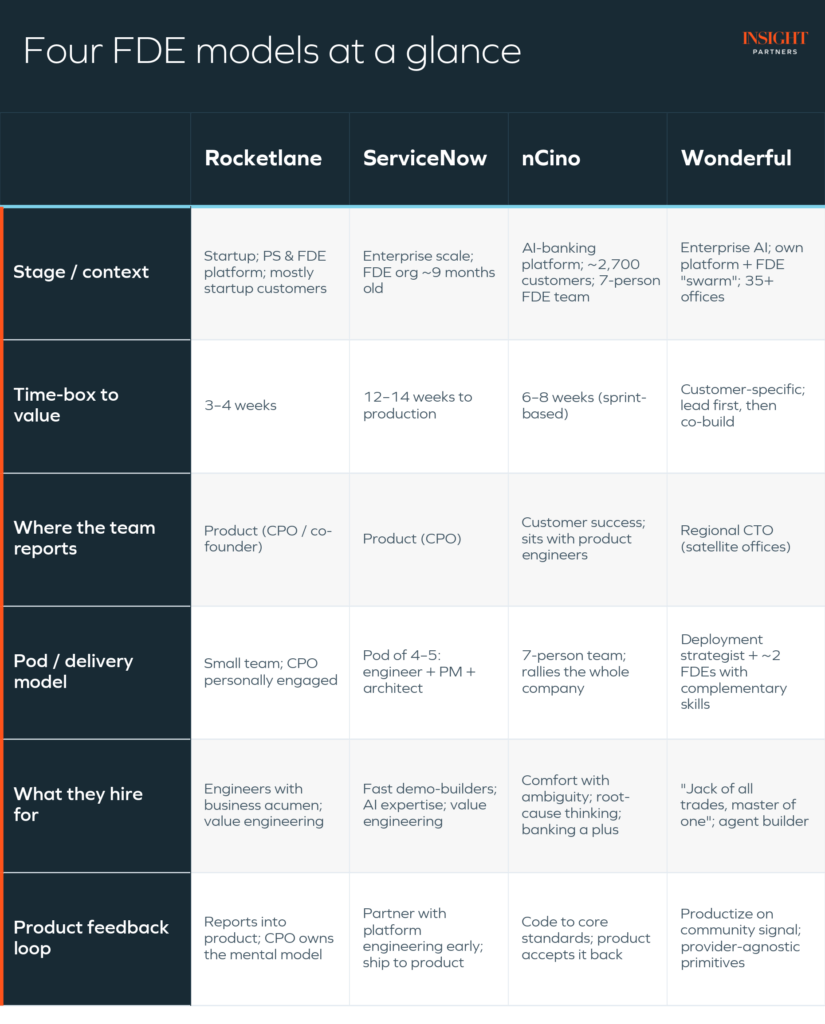
What does a productive day actually look like?
“No two days look the same,” said Michelakis. “I can spend the full day writing code and fixing some bugs. Then I can spend the entire next day without touching my laptop at all, just being deployed at the customer side, making sure that I build relationships with the C-level and the engineering team.” A third day goes to the product and research and development (R&D) team.
That range is key to the job. The panel kept returning to a line Michelakis uses at Wonderful’s Greece office: an FDE should be “a jack of all trades and master of at least one”; a generalist who can still go deep somewhere. Using a football analogy to further illustrate, “Move a defender to attack, and he’s still gonna be an amazing footballer…he won’t match an elite striker, but he can still carry the team.”
A good day, in Ratadia’s words, produces “a clear problem statement, a clear outcome statement.” A bad day is the opposite. Ganesan offered an example of where you travel to a site, get blocked on access, and the momentum dies. Ratadia named a more subtle example of when a customer expects AI to solve a problem it cannot, and the FDE has to reset expectations with the data in hand.
What are the best teams hiring for?
The spike everyone named first was comfort with ambiguity. “The technology is constantly changing, so what it could do yesterday, or couldn’t do yesterday, it can do today,” said Perry. He wants people who get to the root of the problem and then pick the right tool, which is often not AI. “Everyone thinks that AI is this magic hammer that will fix everything, and often it’s not.”
After that, the profiles diverge. Ratadia hires builders who can whip up a demo on the spot, because “a demo is worth way more than the conversations that we have.” Ganesan looks for engineers with the business acumen to run discovery and quantify value; Rocketlane’s first FDE was a hackathon winner, which trains both the build reflex and the ability to explain the build. Michelakis added an aspect that is easy to miss: an FDE at Wonderful is “partly a systems engineer,” responsible for wiring agents into a customer’s real systems, legacy or modern. “It’s a very high ownership role. You’re responsible for making it work.”
How do you structure an FDE engagement?
Every engagement starts by scoping tightly and, often, by explaining what an FDE even is. nCino opens by drawing the line between what its team owns (adoption of its AI “Banking Advisor” capabilities) versus what still routes to implementation, product, or customer success teams. ServiceNow enters strategic accounts, beginning at the C-level to pin down the most important outcome, and then picks a single use case to build. Wonderful tailors to the customer: some want FDEs to lead every deployment, others want their own engineers building on the platform.
The throughline for all engagements is a deliberate hand-off moment. After the initial build, ServiceNow does knowledge transfer so the customer’s developers can maintain the solution, and expansion work is triaged by complexity — some to the FDE team, some to expert services. Wonderful leads first to prove value, then runs workshops to co-build alongside the client’s engineers. And to keep customers from confusing FDEs with the alphabet soup of post-sales roles, both nCino and ServiceNow bring the customer success manager (CSM) and sales rep into the room from the first FDE conversation, as these are the people who provide continuity after the FDE moves on.
How do you keep FDE work maintainable and productizable?
At best, FDE work compounds value; at worst, it can create technical debt. Michelakis sets architectural guardrails up front: no technical debt, and stay “model agnostic and provider agnostic,” because “providers don’t exist tomorrow.” Good primitives are what let a custom-built component become reusable.
The feedback loop into product has to be deliberate. When Ratadia’s team encountered a customer that wanted to bring its own guardrails — a feature ServiceNow did not yet have — the FDEs partnered with platform engineering early, built it, and handed it over to be baked into the product the next quarter. At nCino, artifacts move through Jira and Rocketlane, and FDE code is written to the same standards and tests as core engineering, so the product team can accept it and own it. The test Perry applies to every build is whether it is a one-off or a pattern the team will see “over and over and over again.” Patterns get productized; as he put it, the goal is to “do 1 plus 1 equals 3.”
Ganesan offered the most intentional version of the loop. On one panel, he heard a foundation-model team describe choosing which problems to solve from the product side first, then letting the field find customers who have those problems, pointing FDEs exactly where the product wants to grow.
Where does the team sit, and how do you avoid burnout?
Reporting lines vary by company and stage. FDEs report into product at Rocketlane and ServiceNow, into a regional CTO at Wonderful, and into customer success at nCino, where Perry noted his desk sits among the product engineers anyway. Several teams are edging toward rotation between core engineering and the field so FDEs never feel like second-class engineers.
Burnout is the real risk, and the panel was candid that no one has fully solved it; the demand is relentless. The best defense they named is team depth, not heroics. “It is not one person on an island trying to solve an entire company’s problems on their own,” said Perry. Michelakis kept the football team analogy: build enough overlapping expertise that a teammate can cover for you during a brutal week. That only works if you are selective when you hire, so pods are staffed with complementary strengths rather than clones.
Common FDE misconceptions
A few things about the day-to-day that the panel wanted to put to rest.
“An FDE is a solo hero.”
The durable version is a pod, often an engineer or two, plus a program manager and an architect, backed by the whole company.
“AI is the answer to every engagement.”
Sometimes the fix is a process change or a non-AI solution, and a good FDE can discern this.
“The FDE owns the account forever.”
The FDE comes in for a specific problem and moves on; the CSM and sales rep provide continuity, which is why they are in the room from the first conversation.
“Speed means cutting corners.”
Time-boxing is how these teams prove customers can move fast, not an excuse to skip production rigor.
The bigger picture
Across four very different companies, the same operating system showed up:
- start from the customer’s hardest problem
- attach a number to it
- build in the real environment against a timeline
- hand it off to the customer
- feed what you learned back into the product
The ambiguity never disappears, but this core methodology makes it repeatable. Modern tooling compresses the build cycle into days and weeks, which is exactly what lets these teams deliver value on a calendar rather than a statement of work. The throughline for every builder is simple: an FDE team is not a services line you bolt on later; it is a learning loop you design early, and the companies that treat it that way get a better product, not just a happier customer.
Editor’s note: Insight Partners has invested in Rocketlane, Wonderful, nCino
The portfolio companies and portfolio company executives presented are examples of portfolio companies that Insight has worked with to assist the company achieve business and capital raising goals and are not intended to be a representative sample of all portfolio companies. The statements by portfolio company executives are intended to highlight their experiences working with Insight as an investor in their companies. The experiences of other portfolio companies and portfolio company executives may differ from the experiences presented. Insight did not provide compensation to the portfolio company executives or portfolio companies in connection with the statements provided by such executives. There is no guarantee that Insight’s work with other portfolio companies will produce similar results to those presented.
The post A day in the life: How four companies run FDE motions appeared first on Insight Partners.
]]>